Santiago de Compostela: what to see, where to eat and where to have a drink
The Santiago we'd show a friend: the must-sees, yes, but also the places locals actually go.
The Camino Bonsai Café team · Last editorial update:
A small city you can walk end to end
The old town of Santiago is a UNESCO World Heritage Site and you can cross it on foot in twenty minutes. That changes everything: you don't need transport, and you can see the essentials in a single relaxed day. What really matters is knowing where locals actually go, because the difference between one street and the next can be huge.
This page works whether you've just finished the Camino or you're coming to spend a few days. If you're specifically after the pilgrim's arrival rituals — the Mass, the hug for the Apostle, the Compostela — you'll find them in our guide to what to do when you reach Santiago.
The places worth your time
Roughly ordered as you'd find them walking out from the Cathedral and widening the circle.
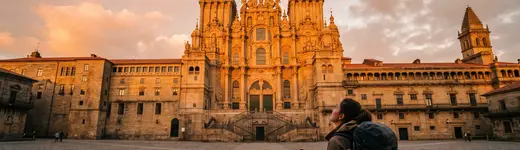
Santiago Cathedral
The end of the Camino. Entry to the cathedral itself is free; the Pórtico da Gloria, the museum and the rooftops are visited separately with a ticket, and it's worth booking ahead.
Praza do Obradoiro
The Camino's postcard shot, and the place where you'll watch pilgrims arrive. Around it: the Pazo de Raxoi, the Colexio de San Xerome and the Hostal dos Reis Católicos, today a Parador hotel.
Praza da Quintana
The square of steps, behind the cathedral. This is where the Porta Santa is, which only opens in a Holy Year. At night, with the façade lit and no crowds, it's probably the best corner in the city.
Praza das Praterías
The oldest surviving façade of the cathedral, with the horses' fountain at its centre. It's named after the silversmiths who worked here, and a few jewellers still remain under the arcades.
Mosteiro de San Martiño Pinario
A stone's throw from the cathedral and far less visited than it deserves. One of the largest monastic complexes in Spain, with an impressive Baroque altarpiece.
Mercado de Abastos
One of the most visited spots in the city after the cathedral, and for good reason: fresh fish and seafood, cheeses, produce from local gardens. Several stalls will even cook what you've just bought.
Parque da Alameda
The classic postcard shot of the cathedral's three towers over the rooftops is taken from the Paseo da Ferradura here. Best at sunset. On the way you'll pass the statue of the Dúas Marías.
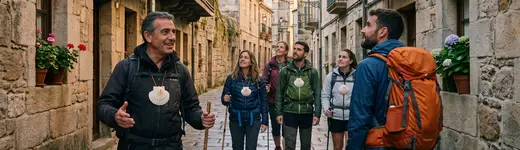
Rúa do Vilar and Rúa Nova
The two arcaded streets, and the arcades aren't just decorative: it rains in Santiago, and they're built exactly so you can stroll without getting wet. Perfect for a drizzly day.
Bonaval: Museo do Pobo Galego and CGAC
A former convent turned museum of Galician culture, with the Centro Galego de Arte Contemporánea next door and a park behind it with views. The less pilgrimage-focused side of the city.
Cidade da Cultura
Peter Eisenman's complex on Mount Gaiás, on the outskirts. Controversial, enormous and very photogenic. You'll need a car or bus: it's not walkable from the centre.
Where to have breakfast and brunch
The first stop of the day, twice as enjoyable once the Camino is behind you.
Bonsai Café
This one's ours, so judge us with that in mind: specialty coffee, weekend brunch and cocktails, right in the centre. If you've just arrived, this is where we like people to celebrate the end of the Camino.
El Tertulia
Small, with a year-round terrace on Rúa do Pombal. Won a Solete Repsol award for its sweet and savoury breakfasts, from churros to a full English. Open from 7:10 am in summer.
Costa Vella
The garden café of the Hotel Costa Vella, with apple and lemon trees and a fountain, right against the medieval wall in the heart of the old town. One of the calmest corners of the city for breakfast.
Where to eat in Santiago
What to order and where to find it.
Pulpo á feira
Galicia's signature dish: boiled octopus, cut with scissors, dressed with olive oil, coarse salt and paprika, served on a wooden plate. Order it by the ración or half, with bread and Ribeiro wine on the side.
Tarta de Santiago
Almond, egg and sugar, with the cross of St James stencilled in icing sugar on top. A good one is moist inside; the packaged version sold in souvenir shops is nothing like it.
Pementos de Padrón
"Some are hot, some are not", and there's no way to tell until you bite in. They come straight from the village of Padrón, one stage away from here on the Camino Portugués.
Rúa do Franco and Rúa da Raíña
The two tapas streets that show up in every guidebook, with laminated menus in six languages and a waiter at the door on every corner. Being on this street doesn't rule a place out: two of our own picks are right on Rúa do Franco.
Las Vegas
At one of the entrances to the old town, next to the Alameda park.
El Papatorio
Right on Rúa do Franco, with an open kitchen and real charcoal grilling. Tapas and sharing plates.
La Noiesa
Also on Rúa do Franco, a family-run place with seafood, rice dishes and octopus. Scallops and blue lobster rice are the most requested. Worth booking ahead.
A Carballesa
A traditional eatery on Rúa de San Clemente, off the main tourist circuit. Short menu built around fresh seafood and classic stews. Closed Mondays and Tuesdays; book ahead, especially at weekends.
Where to have a drink at night
Wine, cocktails and the one tradition you can't skip.
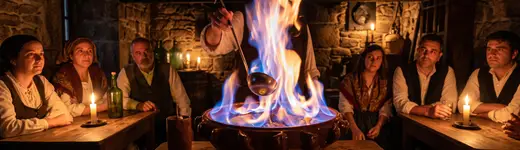
A queimada
Aguardiente, sugar, coffee and lemon peel, set alight and stirred while an incantation is recited to ward off witches. Very Galician, and very much a long-table-after-dinner thing.
Pub Kapital
On Praza de San Pelayo, right in the old town. Livelier music (reggaeton, electrolatino) and the youngest crowd on this list. Open Tuesday to Saturday from 11:30 pm.
Pub Momo
Facing the Mercado de Abastos, with foosball, pool and darts inside, and a garden with a fountain for a calmer drink. Open every day from 4 pm to 4 am.
A Carrilana
Open at pretty much any hour of the day.
Riquela
Wine and tapas at sunset, and a room with live music and drinks by night.
Before and after the city
What to do when you reach Santiago de Compostela
The Pilgrim's Mass, the hug for the Apostle and the arrival rituals, step by step.
How to get the Compostela
Credential, stamps and the paperwork at the Pilgrim's Office.
Camino a Fisterra e Muxía
If you have a few days left, the only route that leaves the Cathedral instead of ending at it.