O Cebreiro to Triacastela
The first entirely Galician stage, through the Sierra de Ancares, with the pilgrim statue battling the wind and a long final descent into Triacastela.
Best season: Spring through autumn; snow, fog and strong wind are common in winter
Map
- O Cebreiro
- Triacastela
FEAACS track published by IGN. Follow current trail signs.
Source: IGN/CNIG · FEAACS · CC BY 4.0 · Accessed:
Gaps in the source file are preserved; no connections have been added.
The Camino Bonsai Café team · Last editorial update:
From O Cebreiro to Triacastela is 20.6 km along the French Way (Camino Francés). It's stage 26, with 273 m of ascent and 901 m of descent, completed in about 4h 45min. Difficulty: Easy.
Through the Sierra de Ancares to Triacastela
This is the first entirely Galician stage of the Camino Francés. The route runs almost the whole way above 1,200 meters elevation, with moderate but frequent ups and downs through the Sierra de Ancares, running parallel to the LU-633 road.
Right after leaving O Cebreiro, the path passes the Alto de San Roque, where a striking bronze statue depicts a pilgrim struggling forward against the wind, cloak billowing behind. Further on, Hospital da Condesa preserves one of the best-kept clusters of pallozas in all of Galicia.
The stage's highest point is the Alto do Poio, at 1,335 meters, reached after a short but intense climb. From there, the path descends continuously all the way to Triacastela, a village whose name recalls the three castles that once guarded this entrance to Galicia.
What the terrain is like, section by section
Terrain
Moderate ups and downs up to the Alto do Poio; then a continuous descent to Triacastela.
Scenery
Beautiful Galician mountains, with meadows, woodland and traditional stone villages.
Path type
Mostly dirt track, running parallel to the LU-633 road.
Villages
Liñares, Hospital da Condesa, Padornelo, Alto do Poio, Fonfría, O Biduedo and Fillobal before Triacastela.
Water points
Good in the villages along the way, with enough options throughout the stage.
Shade
Variable, with wooded stretches and others more open and exposed to the wind.
Traffic
Light, though the path runs parallel to a mountain road.
Key fact
Two-thirds of the stage stay above 1,200 m: snow and fog are common in winter.
Staying in Triacastela
Triacastela offers a good range of albergues after two demanding mountain stages.
Triacastela pilgrim albergue
Run by the Xunta de Galicia, 56 beds across 14 four-bed dorms on Rúa Peregrino s/n. Pilgrim credential required; no reservations, beds are given out on a first-come basis with priority for those on foot. Tel. 660 396 811.
Albergue Aitzenea
Central, on Plaza Vista Alegre 1. Kitchen, washer and dryer; open 15 April to 15 October. Not on Booking, book by phone. Tel. 982 548 076.
A Horta de Abel
Dorm beds and a private room with a garden, on Rúa do Peregrino 5. Open 1 April to 31 October. Tel. 608 080 556.
Complexo Xacobeo
Combines albergue dorm beds and en-suite rooms, with its own restaurant. Calle Cadórniga Carro 4. Tel. 982 548 037.
Hotel Alda Triacastela
A 2-star hotel with en-suite bathrooms, air conditioning and a breakfast buffet. Avenida Camilo José Cela 28. Tel. 982 440 908.
Eating along the route
The mountain villages offer simple, hearty Galician food, ideal after the day's climbs.
Bar-Restaurante O Peregrino
At the entrance to the village, Rúa Peregrino 8. Pilgrim menu and traditional Galician dishes. Tel. 982 548 024.
Casa Núñez
A restaurant inside a traditional palloza seating 100 people, C/ Fonfría 15. Tel. 982 181 271.
Albergue Bar El Puerto
At the stage's highest point. Breakfast €3.50, set menu €10. Tel. 982 367 172.
Stops with history on this stage
The pilgrim-against-the-wind statue
A bronze sculpture by José María Acuña depicting a pilgrim struggling forward with a cloak billowing in the wind, one of the most photographed images on the Camino.
An exceptional cluster of pallozas
One of the best-preserved groups of pallozas in Galicia, a testament to traditional Celtic-origin mountain architecture.
The stage's highest point
At 1,335 meters elevation, it's the peak of this day, reached after a short but demanding climb.
Stop at the Alto de San Roque for the classic photo of the pilgrim battling the wind: it's one of the most recognizable symbols of the whole Camino Francés.
Getting there and back
If you're starting here: O Cebreiro has no direct public transport; the most practical option is arriving from Pedrafita do Cebreiro.
If you need to get back from Triacastela: bus connections are limited; Sarria, a bit further along the route, is usually the most practical option.
What to know before this stage
Prepare for the wind
The Sierra de Ancares is known for strong gusts, especially on the higher stretches.
Don't miss the Alto de San Roque
It's one of the most iconic photo stops on the whole Camino Francés.
Explore Hospital da Condesa
Its pallozas are among the best preserved in Galicia: worth an unhurried stop.
Take advantage of the final descent
After the Alto do Poio, the path drops continuously: a good stretch to regain your rhythm after the previous day's effort.
Don't ruin this stage
Leaving without warm clothing
Wind and temperatures in the Sierra de Ancares can catch you off guard even in warm months.
Rushing through Hospital da Condesa
It's one of the best examples of traditional Galician architecture on the whole Camino.
Getting complacent in winter
Snow and fog are common in this mountain area during the cold months: check the trail conditions.
Not hydrating well
Despite the cooler mountain temperatures, the effort of the final descent still demands good hydration.
What to pack, travel insurance and getting around
One single guide with the recommended gear, useful services (insurance, eSIM) and transport options for the whole Camino.
Work out how much it will cost you
Set the days, route and type of trip, and we give you an estimate of the total cost with a full breakdown.
Everything you want to know before this stage
How many kilometers from O Cebreiro to Triacastela?
Is this stage difficult?
What is the Alto de San Roque?
Why is Hospital da Condesa special?
What is the stage's highest point?
Browse the stages
Things to do in Santiago de Compostela
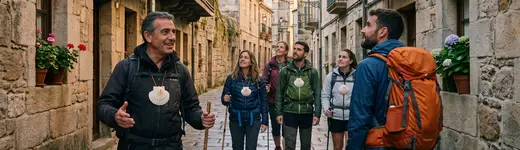
Walking tour of the old town
Small-group walking tour of Santiago’s old town with a local guide.
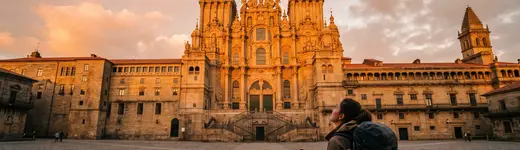
Cathedral and Pórtico da Gloria
Guided visit to the Cathedral with access to the museum and the restored Pórtico da Gloria.
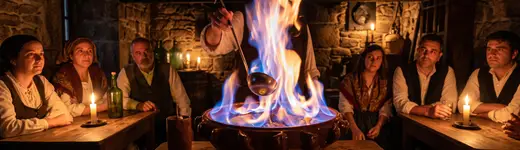
Queimada show and tasting
The traditional Galician flambéed drink, explained in a show designed for pilgrims.
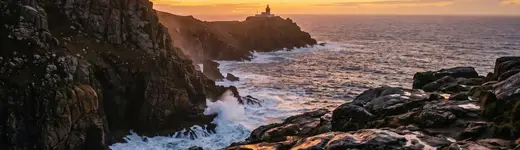
Fisterra, Muxía and the Costa da Morte
The three unmissable stops of the "end of the world" in a full-day trip from Santiago.
Our top recommendation

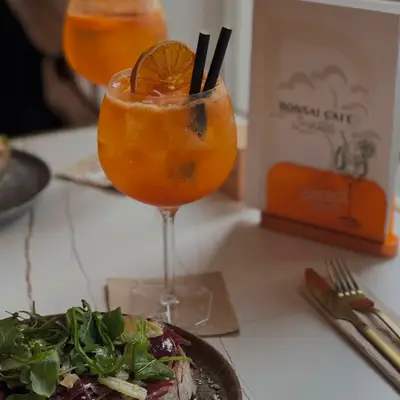
Bonsai Café
You still have stages ahead, but once you reach Santiago you will have earned a good breakfast. Bonsai Café is right in the city centre, with weekend brunch, Berraco by Bou specialty coffee and the best cocktails to toast your arrival.
Map
- Bonsai Café
Transparency: this page contains affiliate links. If you book or buy through one of them, Guía del Camino de Santiago may receive a commission. Read our affiliate policy