Sarria to Portomarín
Rural Galicia at its purest, through meadows and oak and chestnut woods, to Portomarín, the village that rose again stone by stone after being submerged under a reservoir.
Best season: Year-round, with special charm in spring thanks to the lush green woods
Map
- Sarria
- Portomarín
FEAACS track published by IGN. Follow current trail signs.
Source: IGN/CNIG · FEAACS · CC BY 4.0 · Accessed:
The Camino Bonsai Café team · Last editorial update:
From Sarria to Portomarín is 22.2 km along the French Way (Camino Francés). It's stage 28, with 398 m of ascent and 457 m of descent, completed in about 5h. Difficulty: Easy.
Galicia of the small hamlets
This stage crosses the most authentic rural Galicia, through green meadows and lush oak and chestnut forests, dotted with countless "lugares": tiny hamlets that follow one after another along the whole route.
Right after leaving Sarria, the path passes Barbadelo, home to one of the best-kept Romanesque churches on the whole Galician Camino. Elevation changes come often but stay moderate, with no climb or descent that poses a real challenge.
The destination is Portomarín, a village with a singular history: the original settlement was submerged under the waters of the Belesar reservoir in 1963. The new town was built atop a nearby hill, its most important buildings, like the fortress-church of San Xoán, relocated stone by stone.
What the terrain is like, section by section
Terrain
Frequent but moderate elevation change throughout the stage, with no especially demanding stretches.
Scenery
Rural Galicia: meadows, oak and chestnut forests and small traditional "lugares."
Path type
Dirt track and rural path, with good surfaces for most of the route.
Villages
Barbadelo, Ferreiros, Mercadoiro and Vilachá, among many other small hamlets.
Water points
Good and frequent, thanks to the many villages that dot the route.
Shade
Plentiful thanks to the oak and chestnut forest stretches.
Traffic
Light, with the occasional local road crossing.
Key fact
The arrival in Portomarín crosses a bridge over the Belesar reservoir and climbs a staircase up to the village.
Staying in Portomarín
Portomarín has a good range of lodging, thanks to the high volume of pilgrims starting from Sarria on the final 100 km. Grouped by tier; Booking ratings verified in August 2026.
Albergue de peregrinos de Portomarín
Run by the Xunta de Galicia, 114 beds in dormitories of 6 to 30. Pilgrim credential required; may not accept reservations, as public albergues typically operate on a first-come, first-served basis. Tel. 660 396 816.
Albergue Ferramenteiro
Portomarín's largest: 130 beds, individual showers, kitchen and laundry. Rated 7.2/10 on Booking, with over 4,000 reviews.
Albergue Manuel
Right by the bridge over the Miño, on Rúa do Miño. Tel. 982 545 385.
Albergue Aqua Portomarín
100 m from the centre, with private rooms as well as bunks. Rated 8.3/10 on Booking, with close to 1,000 reviews.
Casa Do Marabillas
Free-use kitchen and laundry, 200 m from the square. Rated 8.6/10 on Booking, with over 350 reviews. Open April to October.
PortoSantiago
Portomarín's best-rated lodging, boutique-style, on C/ Diputación 8.
Eating along the route
The many villages along the way offer simple pilgrim bars; Portomarín has a wider selection.
Galician cuisine by the reservoir
Several restaurants with terraces overlooking the Belesar reservoir, ideal for refueling.
Stops with history on this stage
A jewel of Galician Romanesque art
Its 12th-century Church of Santiago is one of the best preserved on the whole Camino, with a finely carved portal.
The village under the water
Portomarín's original settlement was submerged in 1963 when the Belesar reservoir was built on the Miño river.
The fortress-church of San Xoán
This Romanesque-Gothic church, built by the Knights of St John of Jerusalem, was moved stone by stone to the new site of the village.
Look for the numbered stones on some of Portomarín's buildings: physical proof that the entire village was dismantled and rebuilt at its new location.
Getting there and back
If you're starting here: Sarria has a train station and good bus connections, being one of the most popular access points on the Camino.
If you need to get back from Portomarín: it has bus connections with Lugo and Sarria.
What to know before this stage
Don't miss Barbadelo
Its Romanesque church is one of the finest artistic stops on this part of the Camino.
Learn Portomarín's history
Knowing the village was moved stone by stone gives a special meaning to walking its streets.
Book accommodation ahead
The volume of pilgrims leaving Sarria means albergues can fill up quickly, especially in high season.
Enjoy the shade of the forests
It's one of the most wooded stages of this part of the Camino: take the chance to walk at a relaxed pace.
Don't ruin this stage
Rushing through Barbadelo
Its Romanesque church is one of the prettiest in the entire final stretch of the Camino Francés.
Not learning about Portomarín
Knowing the story of the relocated village greatly enriches the visit.
Arriving in Portomarín without a booking
As a heavily traveled stage from Sarria, accommodation can sell out in high season.
Not stamping your credencial in the villages
Take advantage of the many bars and albergues along the route to collect varied stamps.
What to pack, travel insurance and getting around
One single guide with the recommended gear, useful services (insurance, eSIM) and transport options for the whole Camino.
Work out how much it will cost you
Set the days, route and type of trip, and we give you an estimate of the total cost with a full breakdown.
Everything you want to know before this stage
How many kilometers from Sarria to Portomarín?
Is this stage difficult?
Why did Portomarín end up underwater?
What is the church of San Xoán in Portomarín?
What can you see in Barbadelo?
Browse the stages
Things to do in Santiago de Compostela
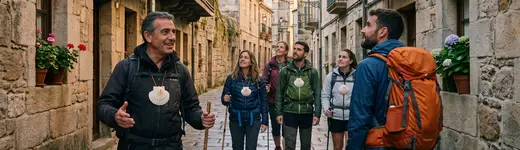
Walking tour of the old town
Small-group walking tour of Santiago’s old town with a local guide.
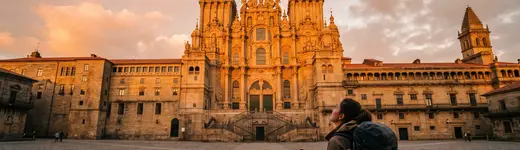
Cathedral and Pórtico da Gloria
Guided visit to the Cathedral with access to the museum and the restored Pórtico da Gloria.
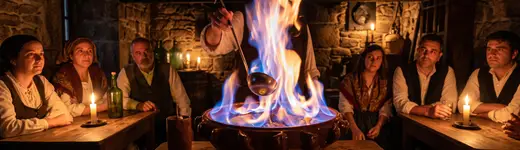
Queimada show and tasting
The traditional Galician flambéed drink, explained in a show designed for pilgrims.
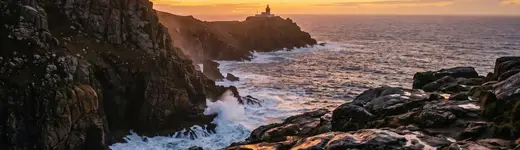
Fisterra, Muxía and the Costa da Morte
The three unmissable stops of the "end of the world" in a full-day trip from Santiago.
Our top recommendation


Bonsai Café
You still have stages ahead, but once you reach Santiago you will have earned a good breakfast. Bonsai Café is right in the city centre, with weekend brunch, Berraco by Bou specialty coffee and the best cocktails to toast your arrival.
Map
- Bonsai Café
Transparency: this page contains affiliate links. If you book or buy through one of them, Guía del Camino de Santiago may receive a commission. Read our affiliate policy