Fisterra to Muxía
The final stage of the Camino: 27.6 km through mountains and woods, running parallel to the coast, to the sanctuary of the Virxe da Barca in Muxía.
Best season: Spring to autumn
Map
- Fisterra
- Muxía
FEAACS track published by IGN. Follow current trail signs.
Source: IGN/CNIG · FEAACS · CC BY 4.0 · Accessed:
Gaps in the source file are preserved; no connections have been added.
The Camino Bonsai Café team · Last editorial update:
From Fisterra to Muxía is 27.6 km along the Camino to Fisterra and Muxía. It's stage 5, with 519 m of ascent and 513 m of descent, completed in about 7 h. Difficulty: Moderate.
The final stage, to the other end of the world
Well signposted in both directions, this final stage crosses a rural and remote landscape, with dirt tracks, woods and some demanding climbs. Despite running parallel to the coast, it has little direct contact with the sea until the final stretch.
Arriving in Muxía has a ritual of its own: the Santuario da Virxe da Barca, built on the rocks facing the ocean, and beside it the Pedra de Abalar, a large stone that, according to tradition, rocks back and forth, and whose movement was once linked to the innocence of whoever stepped on it.
Many pilgrims consider Muxía an even more intimate ending than Fisterra: there are fewer people, and the sanctuary, battered by the Atlantic waves, has a different feel from the lighthouse and kilometre 0.
What the terrain is like, kilometre by kilometre
Terrain
Moderate climbs and descents with some demanding sections, over mountain and woodland terrain.
Scenery
Rural and remote countryside, running parallel to the coast but with little direct contact with the sea until the end.
Type of path
Dirt and forest tracks, well signposted in both directions between Fisterra and Muxía.
Villages
Lires, roughly at the halfway point, is the usual reference for splitting the stage in two if you'd rather.
Water points
Moderate; Lires and Muxía have the best range of services.
Shade
Good in the wooded stretches, more limited in the higher areas.
Traffic
Very low, in a predominantly rural setting.
Key tip
This isn't a beach stage despite running parallel to the coast: carry enough water, as services are limited until Lires.
Accommodation in Muxía
Muxía closes out the Camino with a somewhat smaller range of hostels than Fisterra.
Muxía Pilgrims' Hostel
Xunta de Galicia hostel built in 2006, with 24 bunk beds and 8 adapted for people with reduced mobility.
Albergue Bela Muxía
Private hostel with private and shared rooms, kitchen and laundry, designed for staying a few days after the Camino.
Refuelling on this stage
Muxía, like Fisterra, lives off the sea: a good option for one last fish and seafood meal at the end of the Camino.
Fresh fish and seafood
The village's bars and restaurants, near the harbour, are the best way to celebrate your arrival.
Stops with history on this stage
Santuario da Virxe da Barca
Built directly on the rocks facing the Atlantic, it's one of Galicia's most singular Marian sanctuaries.
Pedra de Abalar
A large stone beside the sanctuary that, according to tradition, rocks back and forth; it was once believed to reveal the innocence of whoever stepped on it.
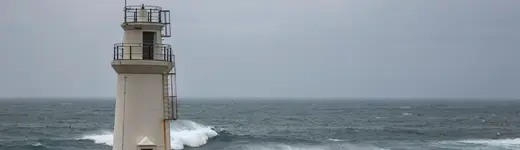
Punta da Barca Lighthouse
Located beside the sanctuary, with privileged views over the same stretch of coast where the oil tanker Prestige ran aground in 2002.
The stage's halfway point
A small rural settlement that serves as the reference for anyone who prefers to split the stage over two days.
The Santuario da Virxe da Barca, with the waves breaking right below it, is an ending as intense as the Fisterra lighthouse, but with far fewer people.
How to get there and how to get back
If you're starting here: Fisterra has several daily buses connecting with Santiago de Compostela.
If you need to get back from Muxía: there are regular buses to Santiago de Compostela, with a journey of about 2 hours.
What to know before this stage
Carry plenty of water
Despite running parallel to the coast, this stage has few supply points until Lires.
Don't mistake it for a beach stage
The profile is mountain and woodland, with demanding climbs; contact with the sea only comes at the end.
Consider splitting it in Lires
If you'd rather have two shorter days, Lires sits roughly at the halfway point.
Arrive at the sanctuary unhurried
Sunset at the Virxe da Barca, with the waves breaking below, is one of the most memorable endings on the whole Camino.
Don't ruin this stage
Expecting a beach stage
Despite being close to the sea, the real profile is mountain and woodland, with more climbing than it looks on the map.
Not carrying enough water
Services are limited until Lires; leave Fisterra with plenty of supplies.
Reaching Muxía without seeing the sanctuary at night or at sunset
The Virxe da Barca in rough seas or at sunset is one of the most memorable sights on the Camino; don't miss it by rushing.
Not checking the return timetable
Bus connections from Muxía to Santiago are good but not very frequent; check the timetable in advance.
What to pack, travel insurance and getting around
One single guide with the recommended gear, useful services (insurance, eSIM) and transport options for the whole Camino.
Work out how much it will cost you
Set the days, route and type of trip, and we give you an estimate of the total cost with a full breakdown.
Everything you're wondering before this stage
How many kilometres are there from Fisterra to Muxía?
Is Fisterra or Muxía prettier?
What is the Pedra de Abalar?
Can this stage be walked in reverse, from Muxía to Fisterra?
Where can I sleep in Muxía?
Browse the stages
Transparency: this page contains affiliate links. If you book or buy through one of them, Guía del Camino de Santiago may receive a commission. Read our affiliate policy